History
1991: Founding of the IUP
Dean Jean-Louis Chanal, convinced of the great value of the IUP (Institut Universitaire Professionnalisé) programs newly created by the Ministry of National Education, established the Montpellier IUP in “Health Engineering” at the School of Pharmacy. Classes began in September of that same year. The IUP offers a three-year program, ranging from the bac+2 to the bac+4 level. The concept was innovative, and the Montpellier program aimed to broaden the scope of education beyond the field of pharmacy alone: the concept of “health” would encompass not only medication and clinical research but also environmental health, radiation therapy and radiation protection, polymers of therapeutic interest, and cosmetology. From the outset, the program includes long-term internships (6 months) in the third year and has secured strong support from the pharmaceutical industry, thanks to the participation of the SNIP (National Union of Pharmaceutical Industries) and major companies such as SANOFI and Pierre Fabre, through the advisory board and teaching staff.
1997: Establishment of the DRT
The D.R.T. (Diplôme de Recherche Technologique) was a postgraduate degree offered by universities that marked the culmination of the technology track for students wishing to pursue a career in research and development. The Montpellier School of Pharmacy, which pioneered the creation of its IUP “Health Engineering” program in 1991, followed up by establishing the corresponding D.R.T., which serves as its natural extension. This DRT, initially maintained under the “LMD” reform, represented an attractive alternative for those who wanted to gain real-world industrial experience immediately (18 months of internship) while pursuing a “bac + 5” degree. The DRT did not survive the European harmonization of higher education (LMD), and the last graduating class completed the program in September 2009. Approximately 100 students earned the DRT, which offered an exceptional employment rate in the field. In its final years, the DRT operated as an apprenticeship program, and students received training in project management and quality management—subjects that currently comprise 2 TU s of the core curriculum in the M2 program.
Establishment of the DESS Programs
Creation of the DESS programs in “Project Management” and “Data Management” (clinical database management). At the suggestion of the Academic Advancement Council—whose members from the industry regularly kept the IUP informed about emerging careers in the healthcare field—these two DESS programs were created, providing a course of study consistent with the IUP and leading to the bac+5 level required to secure a management position in the industry. During the transition to the LMD system, these DESS programs—which had proven their worth time and again—were logically transformed into specializations within the Master 2 program in “Health Engineering.”
2001, Celebration of the IUP's 10th Anniversary
On October 25, 2001, all university officials were in attendance, but the people all the students were most looking forward to seeing were, of course, the two distinguished guests from the pharmaceutical industry: Jean-Jacques BERTRAND, President of the National Union of the Pharmaceutical Industry, President of AVENTIS PASTEUR, and Deputy Chief Executive Officer of AVENTIS PHARMA; and Jean-François DEHECQ, Chairman and Chief Executive Officer of SANOFI-SYNTHELABO and President of the European Federation of Pharmaceutical Industries and Associations. The 2001 graduating class of the IUP and the DESS programs received their diplomas from all of the distinguished guests. Our colleagues from the Fachhochschule in Giessen had also made the trip to attend the ceremony awarding dual degrees to German and French students.
This celebration provided an opportunity to confer the honorary doctorate from the University of Montpellier 1 upon Professor H.J. DE JONG, a professor at Leiden University (Netherlands), Director of International Scientific Relations at the SERVIER Institute for International Research, and Chair of the IUP’s Academic Advisory Board since its inception. It was under his chairmanship that this council successfully aligned the IUP with the pharmaceutical industry and made the right decisions at the right time.
The DRT can be completed through an apprenticeship.
2003, Bicentennial of the School of Pharmacy
October 14–17, 2003: celebration of the 200th anniversary of the School of Pharmacy. Naturally, the IUP in Health Engineering took part in the festivities.
In 2005, the IUP adopted the LMD system
At the start of the 2005 academic year, the IUP transitioned to the LMD system. This was a major milestone in the institution’s history, and everything on this website stems from that change; therefore, we will not delve further into the subject here. Let us simply note a few consequences: the end of the IUP as such (without abandoning any of its core requirements, which allowed the program to retain all its strengths), the conversion of DESS degrees into M2 degrees, the addition of new tracks alongside the two former DESS programs, and the foreseeable end of the DRT.
2006, the Master's Degree through an Apprenticeship Program
Starting in the 2006 academic year, the master’s program can be completed through an apprenticeship. The apprenticeship had proven to be extremely beneficial for the DRT, and the M2 program was structured so that it could be completed through an apprenticeship. Each year, 20–25 M2 students take advantage of this option.
2010, collaboration between UM1 and UM2
To strengthen collaboration between UM1 and UM2 on the “Health Engineering” project, the first semester of the second year (Semester 3) is now largely held at UM2. Students then attend the School of Pharmacy full-time for Semester 4.
2011: Ingénierie de la Santé Celebrates Its 20th Anniversary
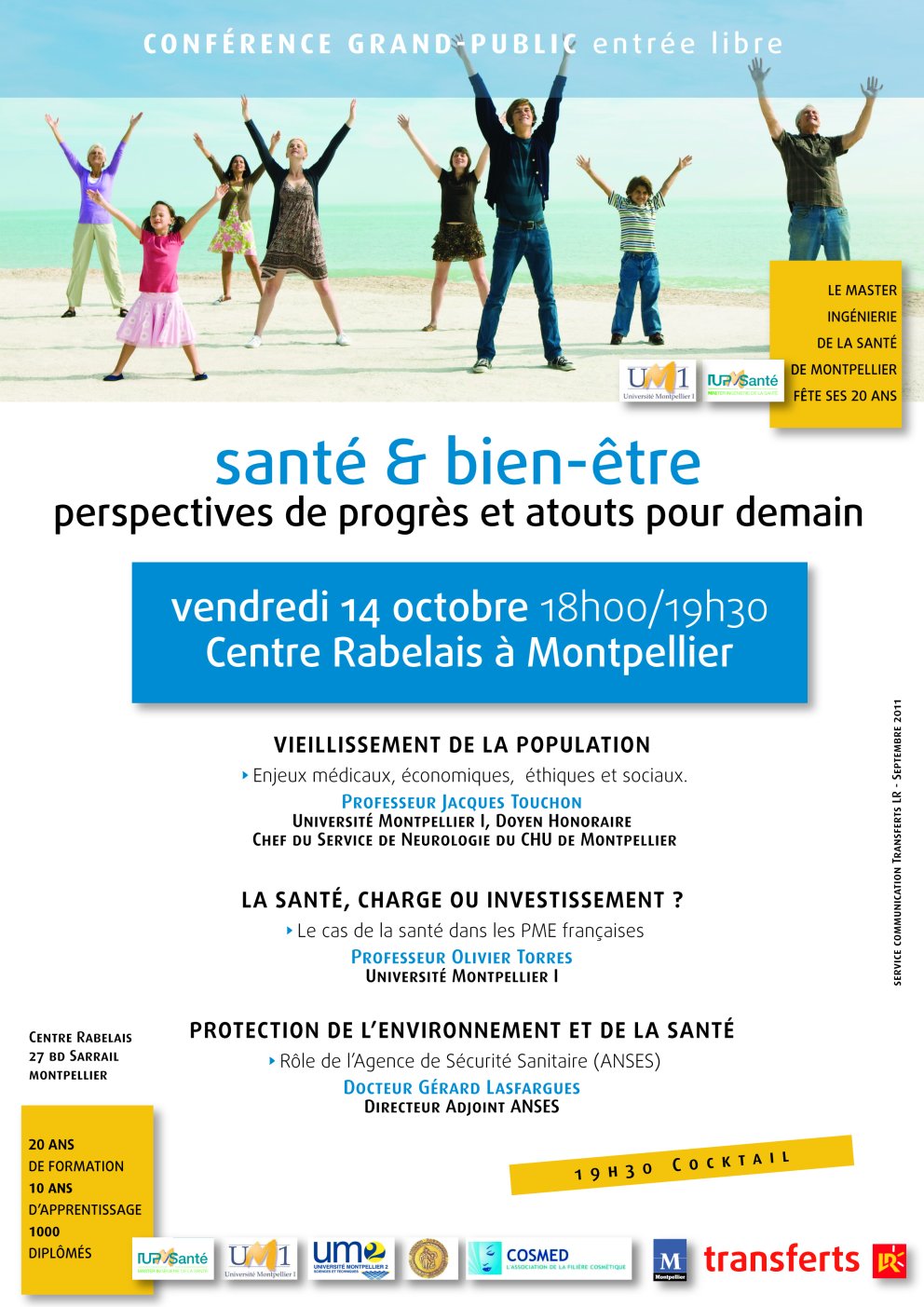
On October 14–15, 2011, the “Health Engineering” IUP celebrated its 20th anniversary:
- Friday: professional seminar, followed at 6 p.m. by a public lecture (on health and wellness);
-Saturday: lectures, alumni reunion, and a discussion on the network's organization;
-Saturday night: the alumni reunion, with some of their teachers
2012, founding member of the REMIS network
In 2012, IS Montpellier was a founding member of the REMIS network (network of health management and engineering schools). The IDEFI REMIS (Initiatives for Excellence in Innovative Training) project ran from 2012 to 2019. The innovative teaching methods and training programs offered by IDEFI-REMIS—designed to closely mirror real-world professional experiences—have reached a broad audience comprising students, employees, individuals undergoing career transitions, and job seekers. These methods and training programs are intended for use by both these audiences and employers.
REMIS has enabled:
- the implementation of innovative methods for designing training programs
- the creation, implementation, and development of the SIMLAB concept;
- the development of international partnerships and networks
- strengthening graduates' transition into the workforce
2016, ISO 9001:2008 certification
The “Health Engineering” program in Montpellier received ISO 9001:2008 certification in February 2016.
2017, ISO 9001:2015 certification
The “Health Engineering” program in Montpellier received ISO 9001:2015 certification in March 2017.
2020: The M1 Apprenticeship Program
Until now, only the M2 program could be completed as an apprenticeship. Now, this is also possible for the M1!
In 2021, Ingénierie de la Santé celebrates its 30th anniversary
This celebration was held in 2022 due to COVID. A symposium was organized, consisting of a day of oral presentations by graduates from various programs. Roundtable discussions followed the presentations.
Download the detailed program.